Hybrid training · Guide
How to build a hybrid training week that works
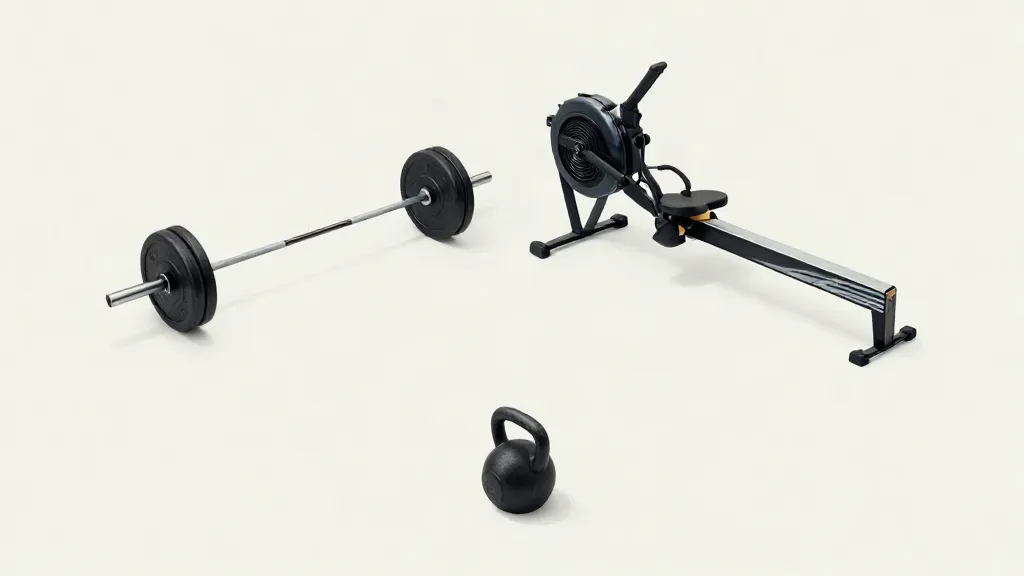
Most training advice assumes you have picked a lane. Lift, or run, or do WODs. But if you are the sort of person who fancies a barbell day on Monday, a long row on Wednesday and a sweaty circuit on Saturday, none of those single-sport templates fit. What you need is a hybrid training plan that holds a whole week together without telling you off for doing what you felt like doing.
Why a hybrid week needs structure, not a rigid template
A rigid template works right up until life gets in the way. You miss Tuesday, the whole week collapses, and by Thursday you are either doubling up or writing the week off. That is not a discipline problem. It is a design problem.
Structure is different from a template. Structure gives you a few rules about how the pieces fit together (how hard, how often, in what order) and then leaves the detail to you. A template gives you a fixed list of sessions and a guilty conscience when you deviate.
If you mix strength, cardio and conditioning in one week, you want the first one. You want a plan that bends rather than breaks. The rest of this guide shows you how to build it.
Start with the days you actually train
Before you choose a single exercise, decide how many days you can genuinely show up. Be honest. Four days you will keep beats six days you will abandon by week three.
For most self-directed hybrid athletes, three to five sessions a week is the sweet spot. That is enough to touch strength, cardio and conditioning without turning every week into a survival exercise.
Write the days down. Monday, Wednesday, Friday, Sunday. That list is your real plan. Everything else is decoration.
Stack the sessions in a sensible order
Once you know your days, decide what each one is for. Two simple rules cover most of it.
Strength first if it is the priority
If building or keeping strength matters most this block, put your heavy sessions early in the week, when you are freshest. A lifting day after a brutal circuit is a lifting day you will under-deliver on, and you will blame yourself rather than the order.
Give hard cardio and WODs their own space
Hard cardio and high-intensity WODs are the sessions that leave you wrecked. Do not stack two of them back to back unless you enjoy being tired all week. Space them out, and treat an easy walk, row or bike as the glue between them rather than another thing to perform.
If you are training for something specific, such as a Hyrox event, a first pull-up or a 10k, say so. Then let that goal decide which session wins when two sessions want the same day.
A sample hybrid training week
Here is one way to arrange four days so nothing fights for the same energy. Treat it as a sketch, not scripture.
- Monday: lower-body strength, plus a short easy row to cool down
- Wednesday: interval cardio, thresholds or a steady tempo block
- Friday: upper-body strength, plus a light circuit to finish
- Sunday: a longer WOD or mixed conditioning session
- Any day: a walk, a few mobility minutes, or nothing at all
Notice what is not here: no session that tries to be everything at once. Each day has one job. That is what keeps a hybrid week sustainable. It is a plan of clear jobs, not a pile of effort. For a lifting-and-running version with every session written out, see a hybrid split.
Keep every session in one place
The quiet killer of a hybrid training plan is scattered data. Your lifts live in one app. Your runs live in another. Your WOD times live in a notebook, or in a photo you took of a whiteboard and never looked at again.
When your history is split across three places, you cannot see the pattern. You cannot tell whether your strength is creeping up while your conditioning stalls, or the reverse. You just feel vaguely tired and assume you are doing it wrong.
One shared history fixes that. Every session (strength, cardio, circuit, WOD) lands in the same place, so the week reads as one story instead of four unrelated ones.
Adjust as the week unfolds
Real weeks do not go to plan, and that is fine. A good hybrid plan has a bit of slack built in.
If you miss a session, do not try to cram it back in on top of everything else. Either let it go, or swap it with the next easy day. The shape of the week matters more than any single box being ticked.
If you feel flat for two sessions in a row, that is information. Cut the intensity, not the habit. Showing up for an easy version beats skipping and feeling behind.
Frequently asked questions
How many days a week should a hybrid plan use?
Three to five. Three is enough to hit strength, cardio and conditioning. Five suits people with a specific event coming up. Anything above five is usually a plan you will not keep.
Should strength come before or after cardio?
If strength is the priority, lift first, or lift on a separate day. If endurance is the priority, run or row first. Trying to chase both at full effort in the same session means you do a mediocre version of each.
Can I run a hybrid plan with limited kit?
Yes. One set of dumbbells, a kettlebell and somewhere to run or row covers a full hybrid week. You do not need a commercial gym to mix strength, cardio and circuits. You need consistency and somewhere to write it down.
Build the week you will actually finish
A hybrid training plan is not a test of willpower. It is a shape you can keep: strength when you are fresh, hard cardio when you can give it, easy work in the gaps, and one place where all of it is recorded.
Start with the days you will really train. Give each session one job. Keep the history in one place so you can see what is working.
Then train. Less tapping, more training.